Interviews
Eric Scouten – Adobe’s Leading Role in the Content Authenticity Boom

Zack Jones
·
·
7 min read
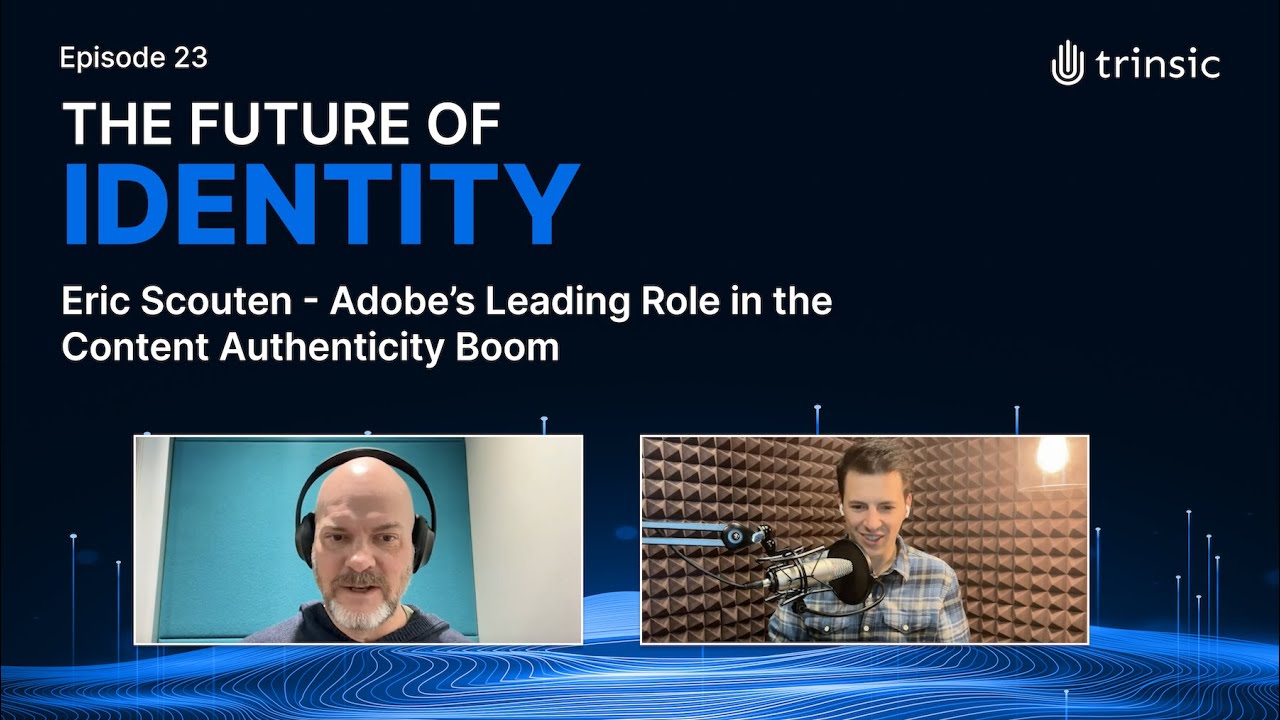
On today’s episode we talked with Eric Scouten, Senior Engineering Manager at Adobe, who has been working for the last four years on solving content authenticity. What does that mean? We’ll get into it in the episode, but suffice it to say that it’s an effort to bring trust to content online.
Was the pope really photographed in that puffy jacket? Was the photo of a war zone really taken this week, or is that from several years ago? And we’ll get into how to identify the identity of the individual or business behind the content, in a privacy-preserving way.
We talk about adoption of the C2PA standard, how the content authenticity initiative recruited so many of the most influential tech and media platforms, and how Adobe built the conviction to ship the first versions into production despite a cold start problem.
We also talk about the user experience of content authenticity, both from the creator side and consumer side, and some thornier issues including potential for censorship and deceit.
This is a fascinating episode into an emerging standard that I believe will be an important part of all our lives over the coming years, and example of incredible innovation coming from a large technology company.
Follow the links to learn more about the Content Authenticity Alliance and the C2PA standard.
Subscribe to our weekly newsletter for more announcements related to the future of identity at trinsic.id/podcast
Reach out to Riley (@rileyphughes) and Trinsic (@trinsic_id) on Twitter. We’d love to hear from you.
Listen to the full episode on Apple podcasts, Spotify or find all ways to listen at trinsic.id/podcast.
Video timestamps from Eric Scouten’s interview
You can watch the full video interview on our YouTube channel, or skip to the timestamps below to find the sections that are most interesting to you.
2:52 – Introduction to content authenticity and the C2PA standard
4:19 – Defining C2PA (Coalition for Content Provenance and Authenticity)
5:07 – How content is tied to individual creators
6:52 – How C2PA differs from other cryptographic assertions like an NFT
9:21 – Building the industry coalition to kickstart adoption for the Content Authenticity Initiative
10:49 – Adobe’s foresight in 2018 regarding the need to address misinformation online
12:43 – The culture at Adobe that allowed them to see need for content authenticity in the age of generative AI
14:12 – The leadership vision to implement the C2PA standard implemented in production
15:22 – How the Adobe team overcame the cold-start problem
17:17 – Adobe’s strategy to prioritize outreach and advocacy in the media industry
18:45 – The user experience considerations of launching C2PA in Photoshop
21:07 – The end-user experience of consuming content credentials
22:54 – How Adobe approaches trust decisions related to content credentials
24:57 – Selective disclosure and choice in asserting user identity
27:07 – How content credentials could transform trust on the internet
29:44 – The paradox of choice that’s holding back the SSI space
32:33 – Eric’s vision for the future of identity
34:09 – How to stay in touch with the Content Authenticity work
How to get in touch
Most people listen to the Future of Identity on Apple or Spotify. Our podcast is also now available as a video interview on YouTube. You can find all ways to listen at trinsic.id/podcast.
As always, you can reach out to our host, Riley Hughes, on X (@rileyphughes) or LinkedIn. We love hearing from listeners! See you again in two weeks.
Full Transcript
Transcript lightly edited for clarity.
Riley Hughes: Welcome to The Future of Identity, a show that surfaces hard-earned insights needed to succeed in the fast-evolving world of digital identity. On The Future of Identity podcast, we skip the conceptual and theoretical conversations and dive into the tactical lessons learned from people in the trenches taking a product to market. I’m Riley Hughes, co-founder of Trinsic, and we are a reusable identity infrastructure company powering dozens of amazing identity products. Today, I talk to Eric Scouten, senior engineering manager at Adobe, who has been working for the last four years on solving content authenticity. What does that mean? We’ll get into it in the episode, of course, but suffice it to say that it’s an effort to bring trust to content online. Was the Pope really photographed in that puffy jacket? Was the photo you saw in the newspaper of a war zone really taken this week, or was that from several years ago? We’ll get into how to identify the identity of the individual or business behind the content as well, of course in a privacy-preserving way.
Riley Hughes: We talk about adoption of the C2PA standard and how the Content Authenticity Initiative that created that standard recruited so many of the most influential tech and media platforms, and how Adobe built the conviction to ship the first versions of this standard into production despite a cold start problem. We also talk about the user experience of content authenticity, both from the creator side and the consumer side, and some of the thornier issues, including the potential for censorship and deceit that arise when you are talking about content online. So this is a fascinating episode into an emerging standard that I believe will be an important part of all of our lives over the coming years, and an example of incredible innovation coming from a large technology company that, you know, didn’t want to get disrupted. So now, I hope you enjoy my conversation with Eric. Riley Hughes: Eric, welcome. Eric
Eric Scouten: Scouten: Thank you. I’m glad to be here. Riley
Riley Hughes: Hughes: I’m so happy to have you on the podcast. You’re working on some incredible things, and in just the last few weeks, I’ve seen announcements from the likes of Adobe, Meta, Google, Microsoft, OpenAI, Sony, and many more related to the work that you are doing. So I’m glad we’re doing this podcast now. We may be able to touch on some more timely things here. But yeah, I’m excited to chat. Eric
Eric Scouten: Scouten: Yes, it’s a great time to be talking about this. There’s been some great new adoptions, as you mentioned, so I’m excited about where we are at the project. Riley
Riley Hughes: Hughes: And that is really what we try to focus on the podcast, is the question of adoption, specifically related to the theme of reusable identity. I tend to see the work that you are involved in as reusable identity for not people, but reusable identity for bits of content. Maybe that framing could use some adjusting, but that’s my mental model. Could you give an introduction to what it is that you’re working on with content authenticity and how that relates to the theme of this podcast, which is identity? Eric
Eric Scouten: Scouten: So I think it’s useful to talk about both what the C2PA is doing in terms of describing content and providing a framework for extensibility, and then I can talk a bit about how we tie that to individual and organizational identity in that extensibility space. The C2PA itself is really aimed at making metadata securely bound to content. When you think about older metadata standards, EXIF, IPTC, XMP, all of those describe the content. There’s a pretty rich framework for what they can say about the content, but there’s no guarantee whatsoever that the attribution there was what was intended. Someone could come along later and say, Well, no, actually, I created this piece of content, or it happened on a different date than actually is true, or a different location. All manner of things can be misrepresented, and there’s really no way to discern that difference in the existing formats.
Eric Scouten: So what we’re trying to do now is say, here are a set of statements that the author or the producer of this content made at the time, and you can be sure that those statements remain true today, or if they are not, that there’s a clear signal that something happened that we can’t account for.
Riley Hughes: You used the acronym C2PA there. Would it be worth expanding on some of the acronyms we might use throughout this conversation?
Eric Scouten: Absolutely, yes. So C2PA is the Coalition for Content Provenance and Authenticity, and the reason we have a two is that about the same time we founded this organization, the state of California created a data privacy law that gave the acronym CCPA. So to avoid confusion, we took a different name, and that stuck with us now. So the core of C2PA is a technical standards organization. It’s a joint development foundation within the auspices of the Linux Foundation. That is really designed for companies across the internet to define this framework for securely binding attributes to the content.
Riley Hughes: You mentioned connecting it to the individual identity and organizational identity. How do those pieces come into the picture?
Eric Scouten: So that’s a piece that we’re actively working on right now. There’s an informal group called the Creator Assertions Working Group, which is run under the Community Specification License, and it’s its own organization separate from C2PA or Adobe or anything else, which is really defining a technical standard for taking credentials that have some attestation about an individual or an organization and binding that also to the content in a way that has that same… Cryptographic binding that says, yes, this person can clearly be shown to be involved in that content. That’s the project really within this overall ecosystem that I am most responsible for.
Riley Hughes: Great. So if I were to summarize this, you know, when I am scrolling on some feed and I see an image, that image has some metadata associated with it. But the metadata is not verifiable, or in other words, I can’t really know whether that metadata is true. And that’s where the content authenticity work that you are doing comes into the picture. And I guess my last question here in this kind of introductory portion of our conversation is that I’ve seen other people trying to tackle maybe a similar problem. over the last, I don’t know, five, ten years or something. And they’ve brought in things like NFTs, where you may be able to have a piece of content and you can use that as the provenance method. Or perhaps you can have a piece of content and do some hashing, you know, and putting things on blockchains. Or you could use verifiable credentials, which are primarily cryptographically signed data.
Riley Hughes: What more is C2PA doing that is different from these other approaches, just so that people can situate C2PA in their mind alongside these other things that they maybe have heard of in the past?
Eric Scouten: The primary thing that I think differentiates C2PA and this ecosystem from, for instance, NFTs is that NFTs are really intended to convey ownership of content. The concept is I produce a unique piece of art, and in some marketplace, I sell that piece of art to you, and theoretically it is yours and yours only. And that’s not the intent of this. This is intended to say, you’re a viewer of content in this social media feed or this news feed, whatever it is. You’re receiving content without any particular concept of who owns it or anything else, but you want to know as the viewer of that content, how did I get this? Who produced it? How? When? What did they do along the way to make that piece of content? And are they willing to attest to those things? And can you believe those attestations? So it’s a very different message than the NFT message, which is about transfer of value. And we’re explicitly not in- That place of marketplace of value transfer. We’re also not about digital rights management, about who has the right to access something. We assume that’s covered in other spaces.
Riley Hughes: Yeah, so who owns it? Who has the rights to it? Those are separate from the sort of provenance data that would be included.
Eric Scouten: Correct. So you can imagine an entertainment space or something like that. The concept of ownership might be relatively fluid over time as legal agreements happen that are perhaps independent of the flow of the content itself. And so we’re careful not to try to describe that legal situation in a way that might conflict with what’s represented digitally.
Riley Hughes: You know, that’s a really good intro. One of the things that I’m really fascinated by is over the last five to seven years that I’ve been in the identity space, I’ve seen a lot of different standards be created or augmented or adopted for different use cases in the identity world. The hard thing about a new standard is getting it adopted. Standards are magical when they’re widely supported, right?
Eric Scouten: Yes.
Riley Hughes: But it’s hard to get the buy-in from everybody involved. And you’ve obviously gotten a lot of buy-in from the likes of some of the highest valued companies on Earth. So I guess, what did it take to get the likes of the Microsofts and Googles and Metas and whatever to adopt? Why are they adopting this and not something else, I guess? Could you speak to any of that?
Eric Scouten: Yeah, some of that I think is luck, but there’s also a lot of work that’s been done on our part and some of the founding members of the Content Authenticity Initiative project. To be really clear that we need that industry coalition, and we invested in the outreach across many sectors to get this. You know, if you go back to the fall of 2019 when we first announced the Content Authenticity Initiative, As a business alliance, the C2PA came later. The founding members of that were social media, news media, and Adobe. And so we were already thinking about how does this reflect across sectors? How do we make sure that this isn’t just an Adobe thing? Because that limits the scope of it in far too many ways. And members have come and gone over that time, but by and large, there’s an understanding that this works because we’ve taken the time to recruit the camera manufacturers. We’ve taken the time to work with news media, with entertainment, with sports, with government, so on and so forth, and build those relationships.
Riley Hughes: The conventional wisdom of getting companies bought into a new approach, a new technology, whatever, right, is that the new technology needs to solve some problem. Is the C2PA solving the same problem? Do these organizations all experience the same pain point that needs to be addressed? And if so, how should I think about what that pain point is?
Eric Scouten: For Adobe, looking back at 2018, 2019 when we started to think that we needed something along these lines, there was an understanding that generative AI would come, that the ability to misinform and mislead people with maliciously constructed content was already an issue and was going to become much more of an issue, and we’ve certainly seen that be true. And the idea that consumers and governments would start to step in and say, hey, we need to understand this and potentially regulate this space. We wanted to make sure that we were out in front of that to ensure that marketplace of creativity was preserved and protected. We’re the purveyors of Photoshop. We want people to be creative with their art. But we also want that to be done in a responsible way. So can you disclose how you got there if you’re putting something into the marketplace, public affairs communications? Can you disclose how did it get from capture to putting into social media?
Riley Hughes: I’m going to step out of the C2PA conversation for just a second. You’ve had quite a great career at Adobe. You’ve been there a while. What is it about Adobe’s culture or Adobe as a company that enabled it to see around this corner so well? We just hear of time and time again in the business marketplace of Blockbuster that if they had their eyes open, should have seen that streaming would be where the world is going, or even in the identity space. there are situations where the old way of doing identity verification, for example, is clearly on its way out and being supplanted by other forms of identity verification, including government-issued eIDs, in Europe, eIDAS 2.0, across the world reusable identities. What is it about Adobe’s culture that enabled you to see around that corner on something that was so, so relevant to the world today?
Eric Scouten: I don’t know how to characterize that. If I were, I’d probably be a president or vice president or something of that order in the company. But I will say that we do have a culture that allows us to talk about and think about risks to our projects and to our core values. People started coming forward years before we formally started this project and saying, Hey, I think there’s going to be something here that you should pay attention to. And we have people who’ve been working in the AI space for many years and stepping up and saying, Hey, we see something coming. Even if you go back to pre the existence of this project, there were certainly content out there that was designed to misinform and mislead. It gets compounded when you add the proliferation of generative AI that we have today.
Riley Hughes: And I think if I were to try to answer my own question a little bit or be my own devil’s advocate here, I could see someone saying, Adobe’s a big company. They’ve been very successful with their various offerings. It’s not that big of a deal for them to hedge their bets a little bit by putting a little money into this research project over here. But what I’m interested in is the first integrations that you were able to do into products like Photoshop. I read a recent blog post of yours and it seems like C2PA is integrated across the board, across half a dozen or more different products. But when that first integration was happening with Photoshop, were you getting pushback of like, Well, this isn’t a problem yet, or, Well, we can push this to next year or to next quarter or something? What was it that got this over the line on that initial integration?
Eric Scouten: Really came from our executive leadership that said, you know, this has never been a research project. This is something we see as the long-term future of the company. So it was clear to us, it was clear to the Photoshop team that this was something that was important and that time and space needed to be made to get it right, but to get it done quickly. There’s always the, hey, can you make this easier? Can you make that adjustment to the overall project? But the do we do this question was never a thing.
Riley Hughes: What about the do this now question? I just know how conversations go within Trinsic, where we’re talking about a feature and it’s like, well, does this need to be done now or can it be done later? And I imagine that in a world where if you’re adding this into Photoshop and this is a standard that is not accepted on any social media platform yet, it’s not integrated into any news site yet, it’s not integrated into anybody’s devices or cameras yet. This is the very first thing, and like almost any standard, it’s virtually useless unless it’s widely accepted. So how was it to get that first thing into production in a world where the ways to consume it were not widely adopted yet?
Eric Scouten: You’re asking the cold start problem. How do we go from zero to having some momentum and then later we build on that momentum? Really, it was strength of will that said, we know that we need this. We’re going to partner with the Photoshop team to have it integrated into a particular version of the product. We’re going to create demonstration projects that show, hey, here’s how it could be used. So we could show the value, we could point other people to that to say, if you join on, this is the benefit that you can provide to your community. There was always the question, can we show that something is working in this space and then build on that? I think that was always a value of us, to get something working. Show that there’s something there that somebody can build on, and then the snowball sort of gradually and then quickly gains momentum.
Riley Hughes: Did it end up playing out in that same way that you expected, or were there hiccups or speed bumps or obstacles along the way that you weren’t anticipating but that would be relevant for this conversation?
Eric Scouten: We all both hoped that it would just sort of be instant, and of course was not. But you start to see gradual adoption. You start to see headlines of this project or this organization has said they will partake in this. And now it’s the question of, okay, so we have that interest. How do we scale that up to a point where people can produce the content at speed and at volume?
Riley Hughes: I’m sure it would be easy for people on the outside to see, wow, this is one of those standards where if you build it, they will come, right? You built it and they came. It also sounds like maybe there were some active efforts in willing that into existence and bringing the right partners around the table. Could you speak to what those efforts look like on a day-to-day, week-to-week, month-to-month basis?
Eric Scouten: One of the early investments and one of the best investments I think that we made in staffing this team was to recruit Santiago Lyon, my teammate, as our director of outreach and advocacy. He has a very long history in news media. He was himself a photojournalist, a war correspondent, and later vice president of photography at the Associated Press. So he has that realm of credibility and connection with large swaths of the news media industry and has been able to draw upon those relationships to advocate on our behalf. That has been a major part of the reason that we were successful in this space, that we’ve been able to build those relationships.
Riley Hughes: I’ve met Santiago and I can see why so many people have been brought into the fold. He’s extremely charismatic. He knows his stuff, and he’s passionate about the problem. And I think that’s a good recipe for success. I know it’s been a lot of work. I look at all these announcements just in 2024 so far, and I’m like, holy cow, this— is an overnight success. But clearly, it has not been an overnight success. Clearly, it’s been in the works for a very long time. Big congrats to your team and to everything that’s going on there. If I’m an end user using Photoshop or maybe Firefly, if I’m creating a piece of content without a content credential, how does that differ from when I’m creating one with a content credential? And what have you learned about the sort of conversion or the opt-in rate or something, if you could share any insights there, that would be interesting.
Eric Scouten: Sure. I don’t have access to the analytics that would tell us what percentage of people are working with that, and I don’t even know what we collect or gather on that front. But what I will say is that we’ve done a lot of user research on both sides of that. The challenge that we face, and this is true of both the content producer and the content viewer, is how do we present enough information to make sure that people have the flexibility and the choice of what they’re producing or what they’re understanding, but not so much that you get lost in this multi-page readout of all the potential details and all the switches that were flipped this way or that. In Photoshop, we’re trying to keep it down to a very minimal set of controls. We instrument Photoshop to record the actions that you’re doing, assuming that you’ve opted into that workflow. But we try to make it as simple as an on-off switch, and then if you switch it on, there are a handful of things that give you control over whether you’re disclosing your identity, you’re disclosing the steps taken, and there are…
Eric Scouten: Arguments depending on what kind of content you’re producing in favor of, against disclosing. We’ll record the other content that you’ve assimilated into your final product, if there is any, things like that. But as I recall, there’s a force switch so that you can flip in Photoshop that controlled this. If you go into the command line application that we produce and report on that, you’ll get pages of detail that are expounding on capture date, production date, steps taken, and so on and so forth. But the fact that’s happening is, for most people in most cases, too much information.
Riley Hughes: It sounds like on the content producer side, content creators can basically have an on and off switch, although there’s a lot more granularity into what’s actually going on. How about on the content viewer side or content consumer side? I’m especially interested in understanding what does the standard say about that user experience? Because I imagine that’s pretty important. The blue check mark on Twitter used to mean something, really doesn’t mean anything anymore. However, that blue check mark signal can be used as a shorthand, and just the presence of that can lead to me as a consumer jumping to conclusions I shouldn’t otherwise jump to. So I imagine the standard probably has something to say about what that experience looks like, and I’m interested if you could speak to that.
Eric Scouten: Yes, we have given a lot of thought to what we call progressive disclosure of that experience. You’ll see on our sites, there’s a hypothetical social media feed, and some of the content is marked with the CR credentials logo, and that’s our level one, is just the fact that this metadata exists and was deemed to be formed, the signatures are intact, things like that. From there, you can get to a secondary report that will tell you some preliminary information about who produced that final content and when and maybe with what tool. And then you can proceed to additional levels of detail should you be interested. We’re trying to— Present enough information for you to make the decisions about whether this content provenance trail is credible and whether it comes from sources that you deem to be trustworthy. And then should you want more information, we can back that up with what we know about the asset. But the overwhelming sense is if we start from all the pages of detail that we actually know about the asset, nobody will read through that, or very few people will.
Riley Hughes: So there’s really two elements, it sounds like. The first element is what information is present, and the second element is how trustworthy is the source of that information, basically. Is the consumer the one that is making those trust decisions, or is there a world in which Twitter will only show the CR logo or only divulge content credentials for things that meet their trust and safety requirements? Is the trust decision always made by the end user, or do the platforms have some role in curating those trust decisions for the end user?
Eric Scouten: That is an area that we’re still actively working towards. I think there are some very interesting and active discussions right now about how do you know that attestation about identity or production tools, so forth, is valid. I hear talk about trust lists, acceptance networks, things like that, that I think will provide some interesting answers. One thing that I want to be really clear about, though, with regard to this ecosystem, is that we’re not attempting to be ourselves assessors of truth. For instance, if you think about a Snopes or a PolitiFact or that kind of thing that fact-checks content, we are explicitly not in that market, right? We’re not going to tell you to believe this news source and not that one. What we do aim to be able to tell you is, did this photograph or this video or this whatever that you are viewing come from the news source? Then really your personal decision as to whether that is a form of reporting that you find credible, newsworthy, trustworthy, so forth.
Riley Hughes: I want to jump back real quick before we leave this topic of user experience, back to the creator side for a moment, specifically on the identity component. If I am a photographer who is photographing things that are controversial or sensitive or where there are really highly wound interests involved, I may want to be anonymous, and my understanding is that the specification allows for that anonymity. But if I get the greatest photograph of the year in National Geographic or something, and I want the world to know my name is associated with this content, or if I have a lot of impersonators and I really want the world to know that this one is actually from me and not from one of these impersonators or something, my understanding is that a lot of the work that you’re doing is to try to tackle that problem. As a creator, what does it look like for me when I’m in Photoshop, Firefly, Lightroom, et cetera? What does it look like for me to assert my identity? What are the ways that I can do that?
Riley Hughes: And then on the consumption side, is there anything else to note around how a viewer would authenticate that information other than just the presence of a claim about a name?
Eric Scouten: As the content producer, one thing that we’re very careful about is to make sure that the presence or absence of your verified identity is your choice. And we want to make sure that if you have safety concerns or other kinds of concerns, that you are empowered to anonymize yourself for your protection. On the flip side, there are also content creators who very much want to identify themselves either as themselves individually or perhaps on the behalf of some organization of which they’re a part. And so the framework that we’re working toward, and this is the Creator Assertions Working Group that we spoke to earlier, is really to allow you to bring credentials that someone has verified on your behalf and use those to sign that content in a way that really binds you to it. There is a trust decision, of course, that the viewer would make about, is the relationship between Riley Hughes and whatever organization attests to your name. One that I trust. Can I see a chain of trust coming back from that ID provider?
Eric Scouten: Because again, you could self-attest to that, and I could self-attest to being Riley Hughes, and that devalues the overall reputation. And that’s something that we want to try to help people understand: what is an identification that should be valuable, and one that’s perhaps more questionable.
Riley Hughes: So I have gotten in the habit of telling my family and my friends and my relatives to simply not trust anything that they see online. Start from the assumption that it’s untrustworthy. In a world with a CR logo on an image, people may not have that same assumption. It’s similar to the blue check problem, which is very useful when it’s correct. But if it’s not fact-checked, right, you mentioned you’re not in the fact-checking business, I wonder if there is a world in which it could be used, you know, to get around that presumption of untrustworthiness and get away with things that are not so good. Have you thought about that, or do you think my fears here are overblown?
Eric Scouten: It’s a legitimate concern, I think. I look back at some content I wrote and published on the internet, I don’t know, 10, 15 years ago, and I’m stunned by the number of sites that I linked to that were plain HTTPs. And today we look askance at anything that isn’t HTTPS. So I really had no idea who I was communicating with at that time. That isn’t to say that because there’s that lock icon in the browser that what’s there is inherently accurate. But if I have a working relationship with the bank that I’m seeing, I do have confidence that the exchange of information and the exchange of instructions that are happening through that browser relationship are ones that I can trust. I may choose to trust this bank over that bank for whatever reasons, and that’s a question of reputation. We are not in the business of reputation scoring. We are in the business of making sure that authentic communications can happen between parties. This part of our work is really about broadcast applications.
Eric Scouten: So as a party that has a large audience, can I establish a relationship with them where they believe that I am actually the one producing this content? And can I stand apart from that torrent of misinformation? So anyway, in that marketplace of information, there’s still room for reputation of who is presenting to you. That’s very much a personal decision, and a one-size-fits-all scoring of the truth or veracity of different sources is not perhaps a wise idea. It’s more, do you trust this entertainer? Do you trust this government agency? Do you trust this news media presenter? That’s a very much individual decision. Do you trust that you are hearing from those parties that I’ve described is a technological question that we can answer.
Riley Hughes: This has been a super interesting conversation. I want to zoom out just a little bit. You’re obviously a very distinguished professional in your career, and I understand you’ve been spending a lot more time on this identity work of late. Coming into the identity space as you have over the last few years, and really diving in to the extent that you are now, what have you observed? What should our community in the reusable identity space, the verifiable credential space, the identity verification space, what should this community be doing differently to improve our chances at improving the status quo and getting better identity technology adopted into the world? What have you observed?
Eric Scouten: One of the challenges I think that the SSI space has is this sort of overwhelming plethora of choices. Not only are there VCs and X.509 certificates and JWTs and mDLs and so on and so forth, but even within any of those, there are still many choices to be made. We look at DIDs, and there’s something like 180 different DID methods today. I think it’s wonderful that there is room for all of the innovation that is behind all of those things, but I think clearer guidance of what does this look like in practice and what are the good consensus-based choices, so that as a developer, I don’t have to actually understand all 180 of those methods or all of the other myriad inflection points that are present to me. I think the role that I have is to sift through that and find implementations that I can bring back to my work at Adobe and to what we put into open source that other people can build upon, and make those suggestions about out of that big universe of potential, how do we focus on something that’s useful and relatively simple to implement.
Riley Hughes: I did an episode with Nick Thomas, who’s one of the founders of the Bluetooth Initiative, and he talked about why Bluetooth didn’t end up with a red tooth competitor necessarily, right? But then you see other standards where there are dozens of them, right? And they’re still not settled, and it almost defeats the purpose of a standard to have 12 different options, as you say. So are there lessons that you can bring from what you’ve observed in the content authenticity space to get so much buy-in around the C2PA standard that would be useful for the identity community?
Eric Scouten: I don’t know how to answer that. I think that we in the content authenticity space were fortunate to have right place, right time, right set of organizations that were similarly motivated, and I don’t see that same sort of Coalescing of purpose in the SSI space. The choices that we make may drive some of that, but that’s a different story than the SSI community as a whole having that inherent focus. And having that inherent focus sort of means choosing not to do some things, which is going to be painful.
Riley Hughes: So, Eric, this has been a wonderful conversation. I appreciate you spending the time. At the end of each episode, I ask for people’s forecast into what the future of identity looks like. I wonder if you could speak to that, and if you want to put your own spin on it framed in terms of content authenticity, that’s fine too. But the question is, what does the future of identity look like to you, Eric?
Eric Scouten: I love this question, and I’m glad that you ask it. When I talk about the work that I’m doing with friends and family and people I meet in the general public, there’s a lot of interest in what we’re doing. And a lot of that comes down to this fatigue that people feel, this onslaught of information designed to misinform and mislead. So they’re really interested in hearing about potential answers to that. The same is true when I have conversations with people in news media, in government, in business, in entertainment, in sports. They’re frustrated that they’re losing contact with their audiences because their identities, their likenesses, their messages are being stolen and corrupted and abused to tell stories that aren’t really theirs. I see us in the technology and identity community stepping forward to say, Hey, we think we can bring you back into genuine contact with each other. And so when I think about the future of identity, I think that you and I and so many other talented people that we work with on the regular…
Eric Scouten: Have a point in the not-so-distant future where we’ve had a really big positive impact on the marketplace of ideas. That’s a future I’m super thrilled about.
Riley Hughes: Wow. Yeah, that’s amazing. Authentic connections and impact on the marketplace of ideas. That’s a future I want to live in as well. So, Eric, do you have anything to plug? If people want to learn more or get in touch or help address some of these challenges that you’ve mentioned here, where should they find you?
Eric Scouten: Of course. So there are three different organizations that I will plug. The first being the Content Authenticity Initiative itself, and that is the name of the business alliance that Adobe is part of, which is interested in promoting this ecosystem of authenticity and provenance in media and broadcast media. The second is the C2PA, the Coalition for Content Provenance and Authenticity. That is the technical standards organization that establishes that framework for authentic provenance. And the final one is the working group that I am primarily heading up, which is the Creator Assertions Working Group. The Creator Assertions Working Group is the place where we are discussing how do you take individual and organizational identity credentials in digital format and bind that to the content so that you can have that trust relationship with content source. And that in particular, for people who are professionals in the identity space, I would welcome participation. I’ll send you links for all of these that you can put into the podcast, into the show notes.
Riley Hughes: Wonderful. Thanks a lot, Eric. This has been an awesome conversation, and I’m really glad that you were able to join us.
Eric Scouten: And I appreciate your invitation to be here.
Riley Hughes: Thanks so much for listening. If you enjoyed this content, please share it with others who will benefit from it. I’ve been getting some great feedback on the podcast recently, and since we don’t do a lot of self-promotion or ads or whatever, sharing the word really is the best way to signal to us that the content is valuable and that we should keep doing it. You can find us on YouTube, Apple, Spotify, and wherever else you listen to podcasts. Feel free to reach out to me directly on LinkedIn or X at Riley P. Hughes, and visit Trinsic if you’re interested in building the future of identity. You can also visit trinsic.id/podcast to subscribe to new shows, and subscribe to the Future of Identity newsletter, where we’ll share the essential reusable identity news we rely on straight to your inbox.
Zack Jones
Director of Product Partnerships @ Trinsic
Zack Jones leads the product partnerships at Trinsic that together form the connections that make up the world’s largest identity acceptance network. Zack is a published author, expert on digital IDs, and passionate about entrepreneurship.
Newsletter
Subscribe to weekly insights and updates in the digital ID ecosystem.